


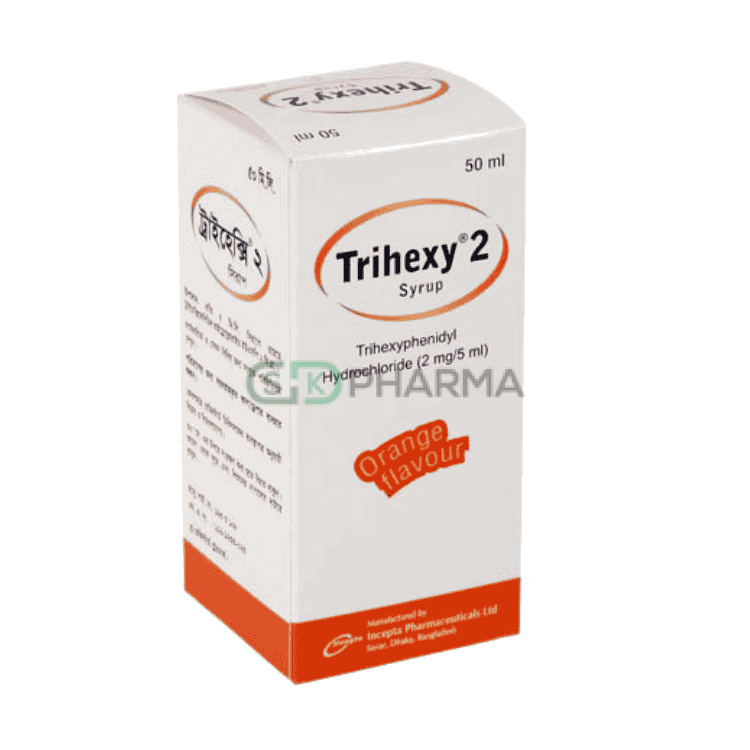
Trihexy Syrup 2 mg/5 ml (Trihexyphenidyl Hydrochloride)
-
 ৳18.80
৳20.00 -
৳3.33
৳3.50 -
৳5.64
৳6.00 -
৳32.90
৳35.00
![Recur Tablet 1 mg (Finasteride [For Androgenic Alopecia])](https://www.skpharma.com.bd/public/uploads/all/mqB5zpgTubYSB0CMtn0XXhQtwBc22ia6JfYbyrMt.png)



Reviews & Ratings
Indications
Trihexy Syrup 2 mg/5 ml (Trihexyphenidyl Hydrochloride) is indicated as an adjunctive treatment for all forms of parkinsonism, including postencephalitic, arteriosclerotic, and idiopathic Parkinson’s disease. It is particularly effective when used in combination with levodopa to improve symptom control in Parkinson’s disease.
Trihexy Syrup is also used to manage extrapyramidal symptoms caused by central nervous system (CNS) drugs such as dibenzoxazepines, phenothiazines, thioxanthenes, and butyrophenones.
Patients should consult a registered healthcare professional before using this medication.
Description
Trihexy Syrup acts by directly inhibiting the parasympathetic nervous system. It also produces a relaxing effect on smooth muscles through both direct muscle action and indirect effects mediated via parasympathetic inhibition. These actions help reduce muscle rigidity, tremors, and abnormal involuntary movements associated with Parkinson’s disease and drug-induced movement disorders.
রেজিস্টার্ড চিকিৎসকের পরামর্শ অনুযায়ী ঔষধ সেবন করুন
Pharmacology
Trihexyphenidyl Hydrochloride is a non-selective muscarinic acetylcholine receptor antagonist with greater affinity for the M1 receptor subtype. Studies demonstrate stronger binding to central muscarinic receptors in the cerebral cortex compared to peripheral receptors.
Evidence also suggests that Trihexyphenidyl may indirectly influence nicotinic acetylcholine receptors, leading to enhanced dopamine release in the striatum. Although the exact mechanism is not fully understood, it is effective in relieving symptoms of Parkinson’s disease and other extrapyramidal disorders.
Dosage & Administration
Dosage should be individualized according to patient response, with a low initial dose recommended, especially in elderly patients over 60 years of age.
-
General Administration:
Trihexy Syrup may be taken before or after meals depending on patient tolerance.-
Postencephalitic patients with excessive salivation may benefit from taking the syrup after meals, sometimes with a small dose of atropine.
-
Patients experiencing excessive dry mouth may prefer taking it before meals, unless nausea occurs.
-
-
Idiopathic Parkinsonism:
Initial dose: 1 mg on the first day
Dose may be increased by 2 mg every 3–5 days
Usual maintenance dose: 6–10 mg daily
Some patients may require up to 12–15 mg daily -
Drug-Induced Parkinsonism:
Typical daily dose ranges from 5–15 mg
Some patients may respond adequately to an initial dose of 1 mg
Dosage adjustments depend on symptom severity and clinical response -
Concomitant Use with Levodopa:
Dosages of both Trihexyphenidyl and levodopa may need to be reduced
Trihexyphenidyl is commonly prescribed at 3–6 mg daily in divided doses
Drug Interactions
Caution is required when Trihexy Syrup is used with cannabinoids, barbiturates, opioids, or alcohol, as these substances may enhance sedative effects and increase the risk of abuse.
Concurrent use with CNS depressants may intensify sedation. Other drugs with strong anticholinergic properties, including monoamine oxidase inhibitors and tricyclic antidepressants, may increase anticholinergic adverse effects.
Contraindications
Trihexyphenidyl is contraindicated in patients with known hypersensitivity to the drug and in individuals with narrow-angle glaucoma, as prolonged use may worsen the condition and lead to vision impairment.
Side Effects
Common side effects include dry mouth, blurred vision, dizziness, mild nausea, and nervousness, affecting approximately 30–50% of patients. These effects are often transient and may subside with continued therapy or dose adjustment.
Rare side effects include severe dry mouth, skin reactions, psychiatric symptoms such as hallucinations or delusions, cognitive impairment, constipation, urinary retention, tachycardia, and increased intraocular pressure.
Abrupt discontinuation may worsen Parkinsonism or precipitate Neuroleptic Malignant Syndrome.
রেজিস্টার্ড চিকিৎসকের পরামর্শ অনুযায়ী ঔষধ সেবন করুন
Pregnancy & Lactation
There are no adequate and well-controlled studies in pregnant women. Trihexyphenidyl should be used during pregnancy only if the potential benefits outweigh the possible risks.
It is not known whether Trihexyphenidyl is excreted in human breast milk. Caution is advised when administering to nursing mothers, as it may suppress lactation.
Precautions & Warnings
An ophthalmic evaluation, including gonioscopy, is recommended before initiating therapy, with regular monitoring of intraocular pressure. Trihexyphenidyl may precipitate angle-closure glaucoma, which can result in vision loss.
Use with caution in hot environments, in elderly patients, and in individuals with CNS disorders or those performing heavy physical labor, as impaired sweating and hyperthermia may occur.
Overdose Effects
Overdose may cause anticholinergic toxicity, including dilated pupils, dry skin, tachycardia, fever, agitation, and delirium. Severe cases may lead to coma, respiratory failure, or death.
Management includes symptomatic and supportive care, gastric lavage, diazepam for CNS excitation, fluid replacement, and respiratory support. Trihexyphenidyl is not known to be dialyzable.
Therapeutic Class
Antiparkinson Drugs
Storage Conditions
Store in a dry place at a temperature not exceeding 30°C. Protect from light.
Related Products
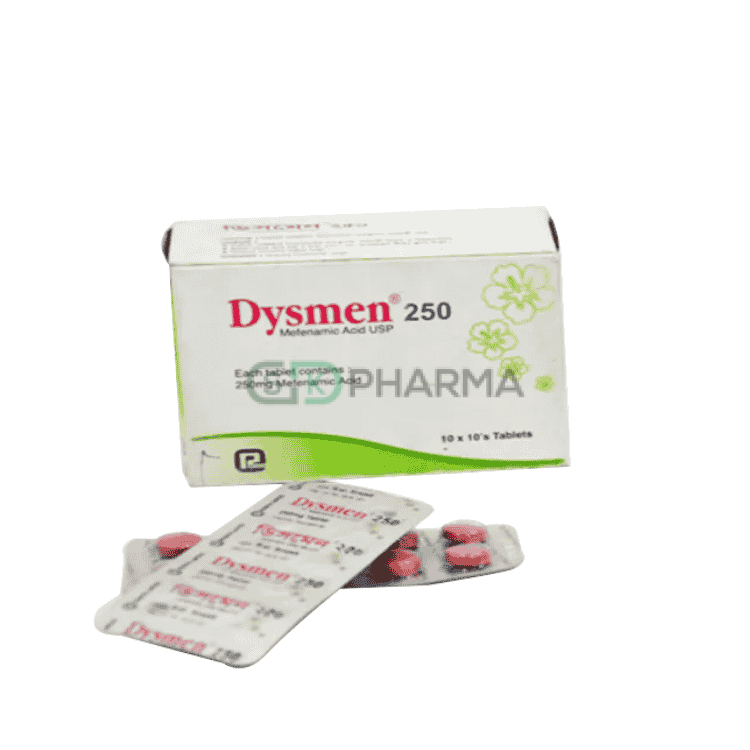
Dysmen Tablet 250 mg (Mefenamic acid)

Ornopain Tablet 8 mg (Lornoxicam)

Steron Tablet 0.5 mg (Dexamethasone)
![Emcon 1 Tablet 1.5 mg (Levonorgestrel [Emergency contraceptive pill])](https://www.skpharma.com.bd/public/uploads/all/hY9byLesdd3Vtmfe4EQUMNJWqoN1V7uGBJthLPsW.png)
![D-Balance Injectable Solution (Oral & IM) 200000 IU/ml (Cholecalciferol [Vitamin D3])](https://www.skpharma.com.bd/public/uploads/all/h9BZW83yKORw3lFJS6uc6t3PI6bGrsSnZ12jJfzH.png)
Folix Tablet 5 mg (Folinic Acid)
![Momvit Tablet (10 Vitamin & 6 Mineral [Pregnancy and Breast Feeding Formula])](https://www.skpharma.com.bd/public/uploads/all/9wTUEAD6cpJBkHqBfJEGfVAPuaPBHRz2GXccxayh.png)
Product Queries (0)
Login Or Registerto submit your questions to seller
Other Questions
No none asked to seller yet
-
৳18.80
৳20.00 -
৳3.33
৳3.50 -
৳5.64
৳6.00 -
৳32.90
৳35.00


